
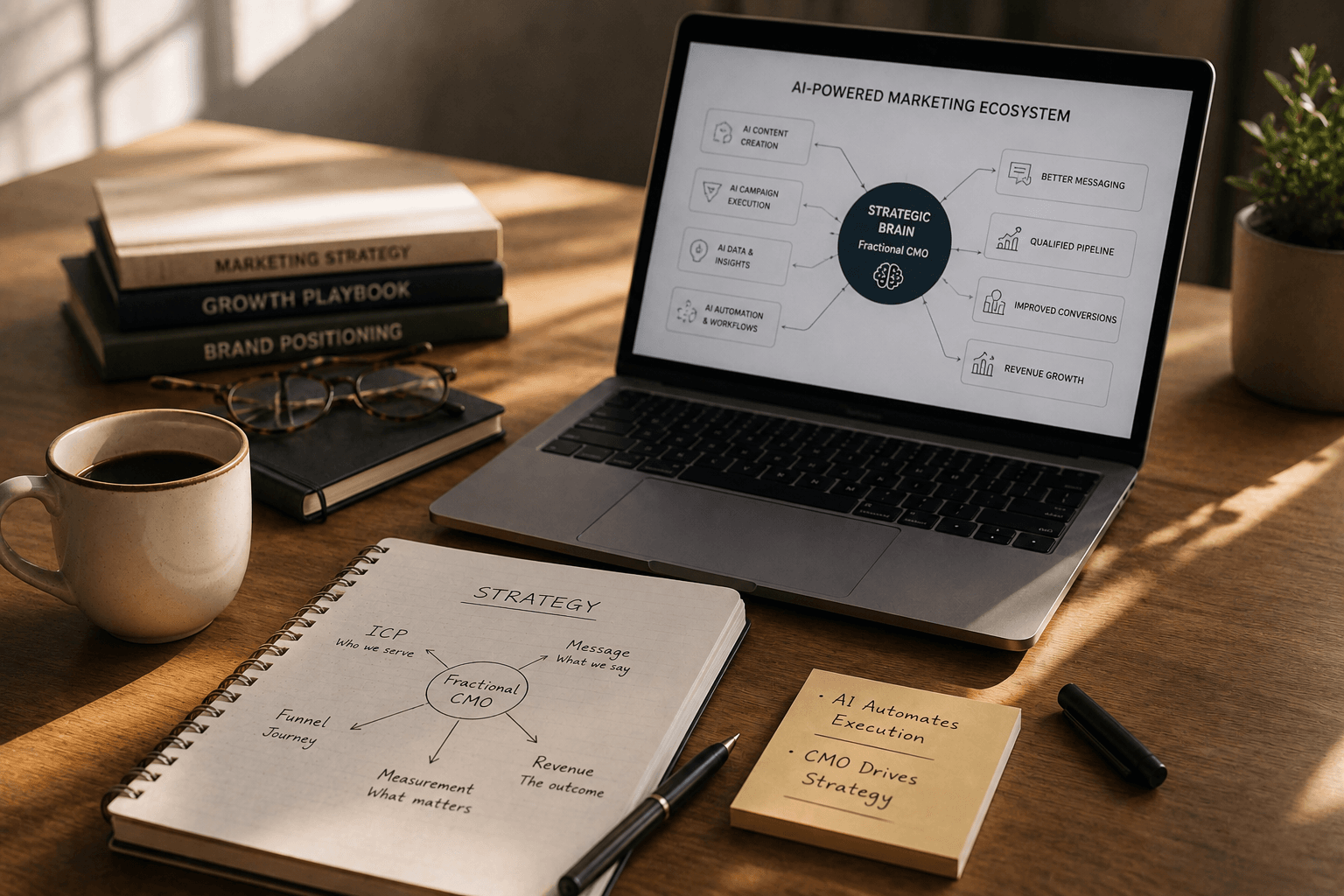
We’re all working in organisations that are using AI to produce more content in less time. But what most of them don’t have is someone making sure any of it is pointing in the right direction.
And I think that’s the gap a fractional CMO fills in 2026. And it’s a bigger gap than ever.
More output, same old problem
I keep seeing business leaders and department heads discovering AI tools, and within a few weeks, content output has doubled. More blog posts, email campaigns, social updates with EM Dashes. It all starts streaming out.
And at the start, it all feels quite positive, but after a month or so, none of the business metrics has moved. Traffic hasn’t increased, leads are the same, and the sales team have their usual gripes.
And all that is because the problem was never content volume.
According to McKinsey research published earlier this year, nearly 90% of marketing leaders are now experimenting with AI. But fewer than 10% have actually captured value across their end-to-end marketing. The kind of value that shows up in your marketing funnel, sales pipeline and revenue.
I think the gap between using AI and getting results from it is a strategy problem.
What AI actually changes (and what it doesn’t)
There are definitely things that AI is good at. It can draft faster than any human, it can test ten headlines where you used to test two. It can repurpose a webinar into a newsletter, a blog post, and a set of social captions in the time it used to take to write one of those. Some of the newer agentic tools can update your CRM, segment your audience, and adjust your ad spend without a human touching it (which still keeps me awake at night).
But it can’t tell you whether your ICP is right. It can’t decide whether you’re going after the wrong market segment. It can’t notice that your sales team keeps losing deals at a specific point in the conversation because the messaging you’re sending before that conversation is creating the wrong expectations. It can’t look at your funnel and recognise that the problem isn’t top-of-funnel at all, it’s that nobody’s nurturing the leads who went cold six months ago.
Those are judgement calls that require context and pattern recognition, and the ability to connect marketing activity to commercial outcomes. AI can amplify your execution, but it can’t replace your thinking. When the thinking is removed, then AI just creates more problems, faster.
The fractional CMO’s actual job right now
I don’t come into a business to run campaigns. I come in to make sure the campaigns being run are the right ones.
In practice, that means a few specific things.
Working out what success actually looks like.
Before touching a single piece of content or a single channel, I want to understand what the business needs from marketing. Not “more leads.” Something more specific like a revenue target, a market they’re trying to break into, a product they’re trying to move, a deal size they’re trying to move upmarket towards. That sets the direction for everything else.
Sorting out the ICP.
Most growing businesses have a vague sense of who they sell to. A fractional CMO sharpens that into something a team (and an AI) can actually act on. Who specifically? What problem do they have? What language do they use to describe that problem? What makes them buy, and what makes them stall? Without this, AI-generated content is shooting in the dark at twice the speed.
Building the measurement layer.
If you can’t see what’s working, you can’t make better decisions. One of the first things I do in most engagements is replace the vanity metric reporting like impressions, followers, email open rates, with a view of the funnel that actually connects marketing to revenue. MQLs to SQLs. Drop-off rates. Where leads are stalling. That data is what lets a team (and their AI tools) course-correct in real time rather than finding out six months later that the strategy wasn’t working.
Being the connective tissue between marketing and sales.
Marketing’s job doesn’t end at the MQL. I spend a lot of time in the handoff between the two teams, understanding what sales are actually experiencing in conversations, feeding that back into messaging, and making sure marketing is supporting the full sales process, not just the top of the funnel.
None of this is something you automate.
There’s a version of the argument that I’ve read that talks about AI coming for marketing jobs, including the CMO.
Why pay for a senior marketing brain when a model can run a campaign?
I’d make the opposite case.
When execution becomes cheap and fast, the thing that differentiates one company from another is the quality of the decisions being made at the top. If every business can now produce good content at volume, the question becomes: who’s producing the right content? Who’s making sure the messaging is specific enough to land? Who’s looking at the whole funnel and asking where the bottleneck actually is?
Strategy has always mattered. But when execution was slow and expensive, there was more time to notice when something was going wrong before you’d invested too heavily in it. Now you can be wrong at speed, producing six months of AI-generated content pointed at the wrong audience and not know it until you look at the pipeline numbers.
The fractional CMO’s job is to make sure that doesn’t happen.
What this looks like in practice
I work with a range of businesses, B2B software companies, SaaS products, service businesses in growth mode. Across all of them, the AI story is the same: more capacity, same strategic questions.
What I bring isn’t another tool. It’s a framework for deciding which tools to use, in which order, pointed at which goals.
The businesses getting the most out of AI right now aren’t the ones with the most sophisticated tools. They’re the ones who were clear on their strategy before they started using them, who their customer is, what they’re selling them, and what they need marketing to do for the business.
That clarity is what a fractional CMO builds. And once it’s there, the AI does the rest faster than ever.
If your marketing team has the tools but you’re not sure the effort is going in the right direction, that’s usually the sign that something strategic is missing. Feel free to get in touch.