
Every business says they’re busy, but how do you know if you are busy with the right things?
When priorities are unclear, teams default to activity, and the activity that they enjoy personally, not that has the biggest value for the business. Meetings start to multiply, tasks stack up and everyone looks busy. But nothing really moves the needle that much.
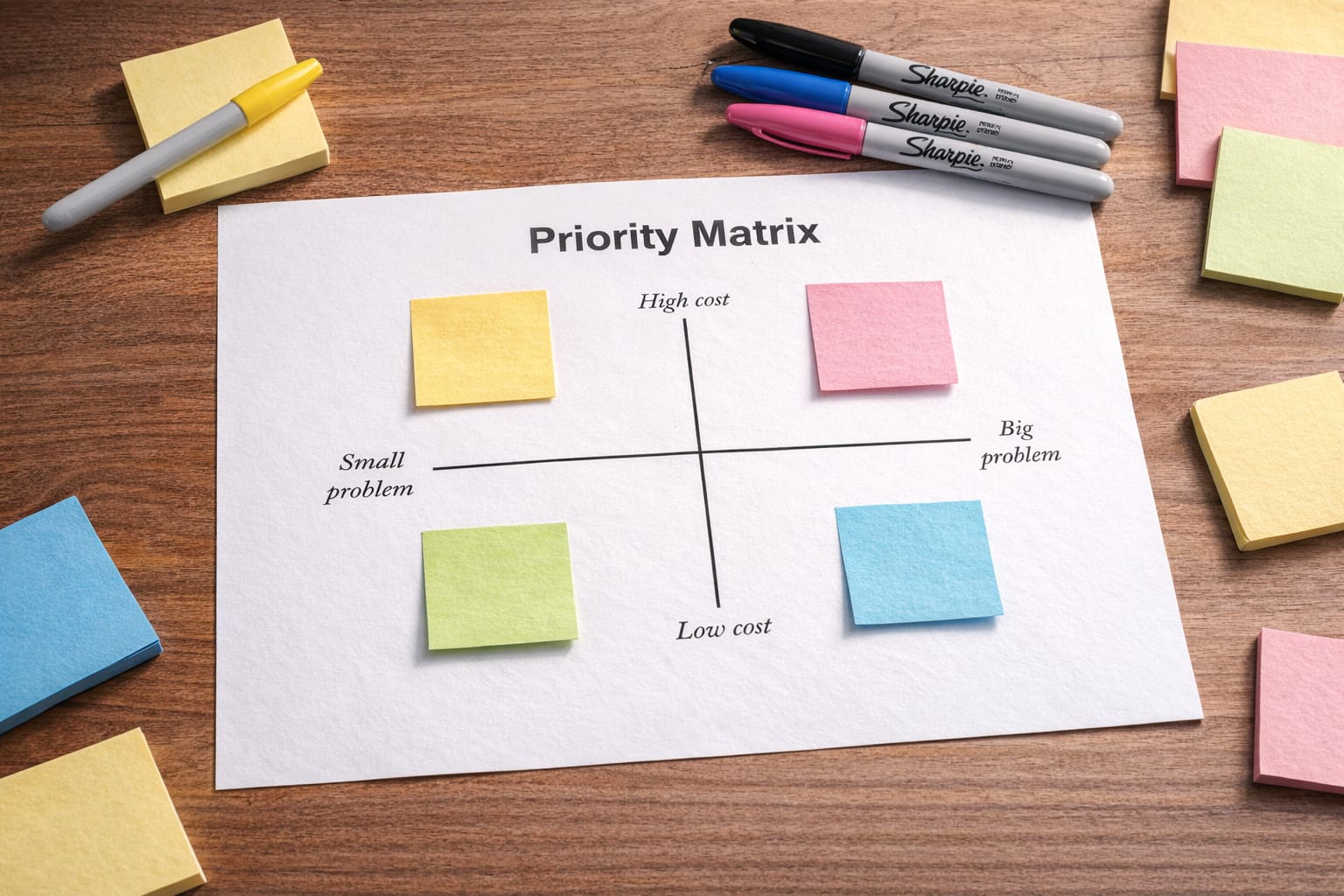
When I’m working with leadership teams, I often pull out one very simple tool to reset focus
If you want to run this with your own team, Pip Decks have a really good “Priority Map” write-up, plus a ready-made Miro board you can copy and use in 10 minutes.
The Effort vs Impact prioritisation matrix
Now this isn’t anything that is new, exceptionally complex and clever, but I think the simplicity is why this works so well.
The Effort vs Impact Matrix
On one axis, you’ve got Effort (low to high).
On the other, Impact (low to high).
Every initiative, campaign, project, or idea gets plotted somewhere on that grid.
By doing this, it’s amazing the conversations you start to have in the business.
Quadrant 1: Low Effort / High Impact
(Do These First)
This is where momentum comes from.
These are the changes that don’t require months of planning, budget sign-off, or new headcount, but unlock disproportionate value.
Typical examples:
- Clarifying a confusing value proposition
- Fixing a broken handoff between sales and marketing
- Improving one high traffic landing page
- Saying no to a low quality channel that drains time
These are often obvious in hindsight but they’re often buried under all the noise.
This box shouldn’t be empty, but if it is, then you probably have a clarity problem.
Quadrant 2: High Effort / High Impact
(Big projects that are strategic bets)
This is where transformation lives. New platforms, propositions, markets or structural changes.
They matter but they take a lot more of your time and can be distractions.
The mistake teams make here is treating everything like it belongs in this quadrant.
Not everything deserves a roadmap or a steering group.
Always ask this one question…
“If this takes twice as long and costs twice as much, is it still worth doing?”
If the answer isn’t a clear yes, it probably doesn’t belong here.
Quadrant 3: Low Effort / Low Impact
(Nice to Haves)
These are the tasks that feel safe, easy to do and create visual output.
They rarely change outcomes, things like copy changes, internal decks, monthly reports that nobody reads.
These things aren’t wrong but they’re just not priorities.
The danger is letting these fill the gaps between real work and slowly becoming the work.
Quadrant 4: High Effort / Low Impact
(Where Time Goes to Die)
I call this the “graveyard of good intentions”
Big projects with heavy process and not much upside.
Common examples I’ve seen:
- Over-engineered tools that no one adopts
- Campaigns chasing marginal audiences
- Complex reporting built “just in case”
- Replatforming without a commercial reason
If something lands here, then either kill it, pause it or radically simplify it.
Where It Normally Breaks Down
Most teams don’t disagree on effort, but I’ve found there can be issues agreeing on impact.
Someone in marketing is shouting that brand is important, product are focusing on features and you have a CEO wanting everything at the same time.
That’s where the matrix forces alignment, because you can’t hide behind activity, you have to decide what will move the business.
When I run this exercise with clients, the value isn’t the grid, it’s the lightbulb moment when everyone realises they’ve been working hard, but just not together.
A Simple Rule To End…
If everything is a priority, nothing is.
High impact, low effort work is rare.
High-effort work should earn its place.
And anything that’s high effort and low impact is quietly stealing growth.
Most teams don’t need more ideas, just fewer, better decisions. That’s what this map is really for.
And it also protects marketing decisions. If a CEO walks in with a new project inspired by a podcast they listened to on the way into the office, ask them where it sits on the matrix, and what should move down the priority list as a result.

Before You Interview a Fractional CMO, Answer These Three Questions
There’s no shortage of checklists telling you what to ask a fractional CMO before you hire one, like track record, day rate, sector experience. If they’ve got a fellowship after